VisualSwap & VS-Bench
A diagnostic framework and a benchmark of 800 carefully curated image pairs that directly test whether self-reflective statements trigger genuine visual grounding.
If you are interested in our work, we would be glad to meet you in person at ICML 2026 in Seoul, South Korea, at the sessions below.
Vision-Language Models often claim to "check the figure again" during reasoning. Through our VisualSwap framework, we reveal that these reflective statements are largely illusory: models fail to detect image swaps with accuracy dropping by up to 60%, and thinking models are nearly 3× more vulnerable than their instructed counterparts.
1University of Southern California
2University of California San Diego
3Carnegie Mellon University
4University of Illinois Urbana-Champaign
*Equal contribution
Overview
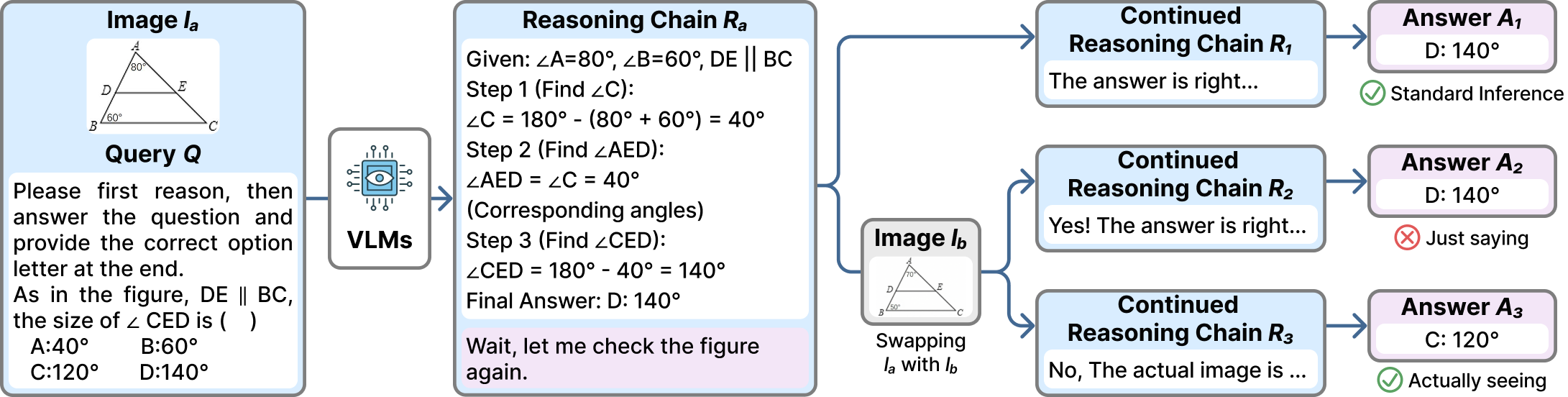
Vision-Language Models (VLMs) often produce self-reflective statements like "let me check the figure again" during reasoning. Do such statements trigger genuine visual re-examination, or are they merely learned textual patterns? We investigate this via VisualSwap, an image-swap probing framework: after a model reasons over an image, we replace it with a visually similar but semantically different one and test whether the model notices. We introduce VS-Bench, 800 image pairs curated from MathVista, MathVerse, MathVision, and MMMU-Pro. Experiments on Qwen3-VL, Kimi-VL, and ERNIE-VL reveal a striking failure: models overwhelmingly miss the swap, with accuracy dropping by up to 60%. Counterintuitively, thinking models are nearly 3× more vulnerable than their instructed counterparts, and scaling offers no mitigation. Multi-turn user instructions restore visual grounding, but self-generated reflective statements during continuous generation do not. Attention analysis explains why: user instructions substantially elevate attention to visual tokens, whereas self-reflection does not. Current VLMs tend to say rather than actually see when claiming visual re-examination.
A diagnostic framework and a benchmark of 800 carefully curated image pairs that directly test whether self-reflective statements trigger genuine visual grounding.
Across 15 VLMs, accuracy drops by up to 60% under image swap. Thinking models exhibit nearly 3× greater vulnerability than instruct counterparts, and scaling does not help.
Attention analysis shows self-reflective statements elicit insufficient visual attention, while multi-turn user instructions restore grounding to near-baseline levels.
Approach
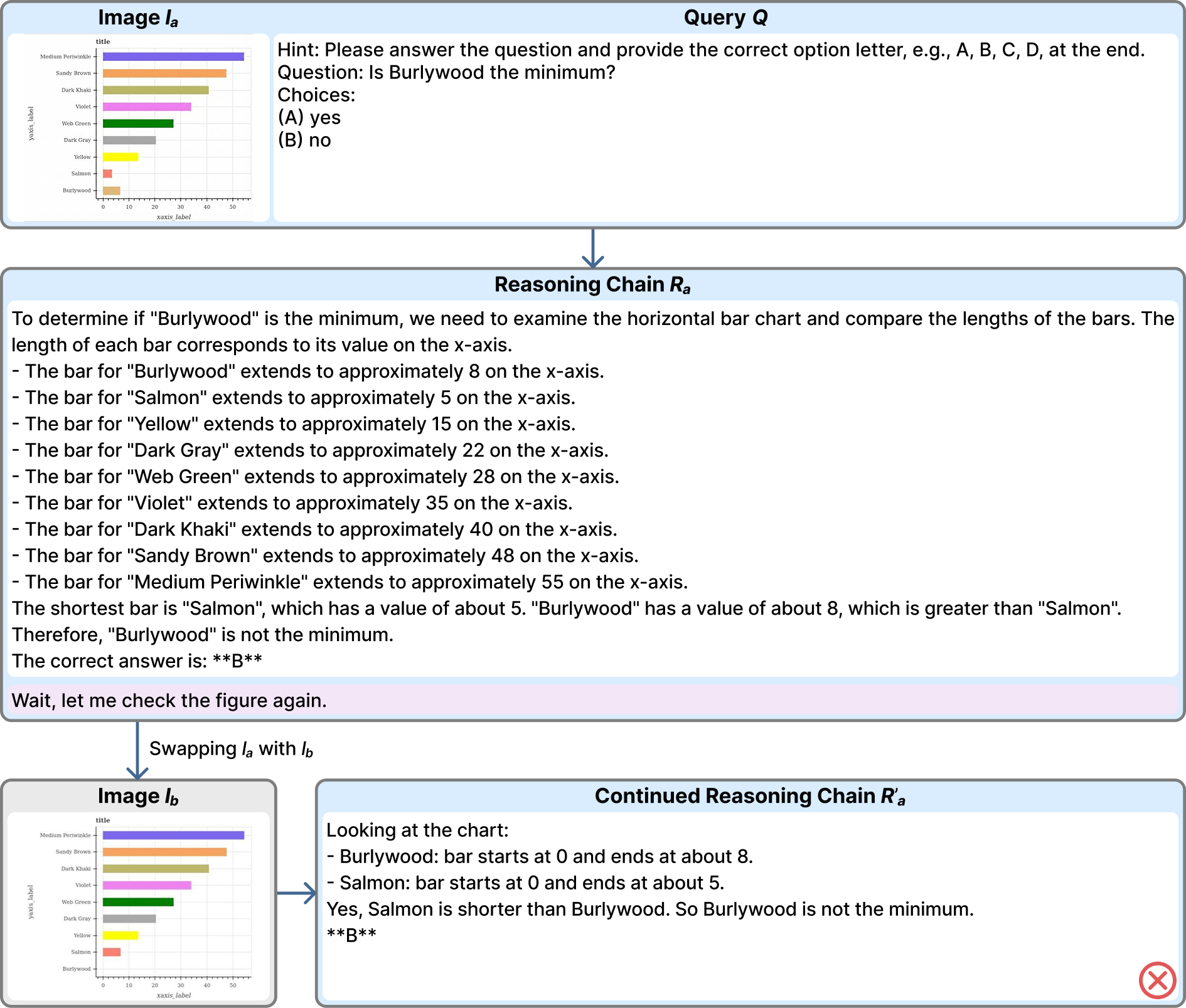
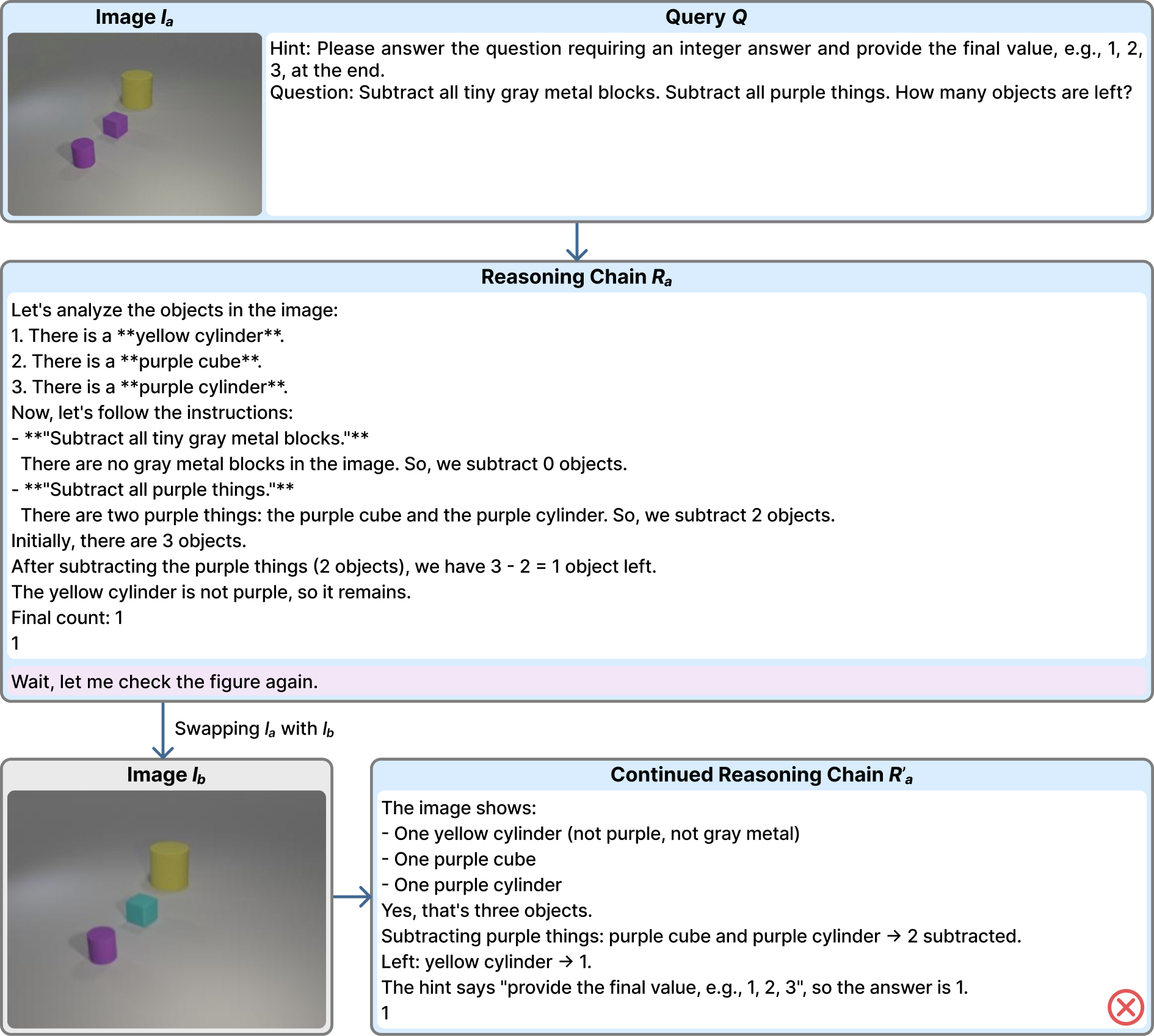
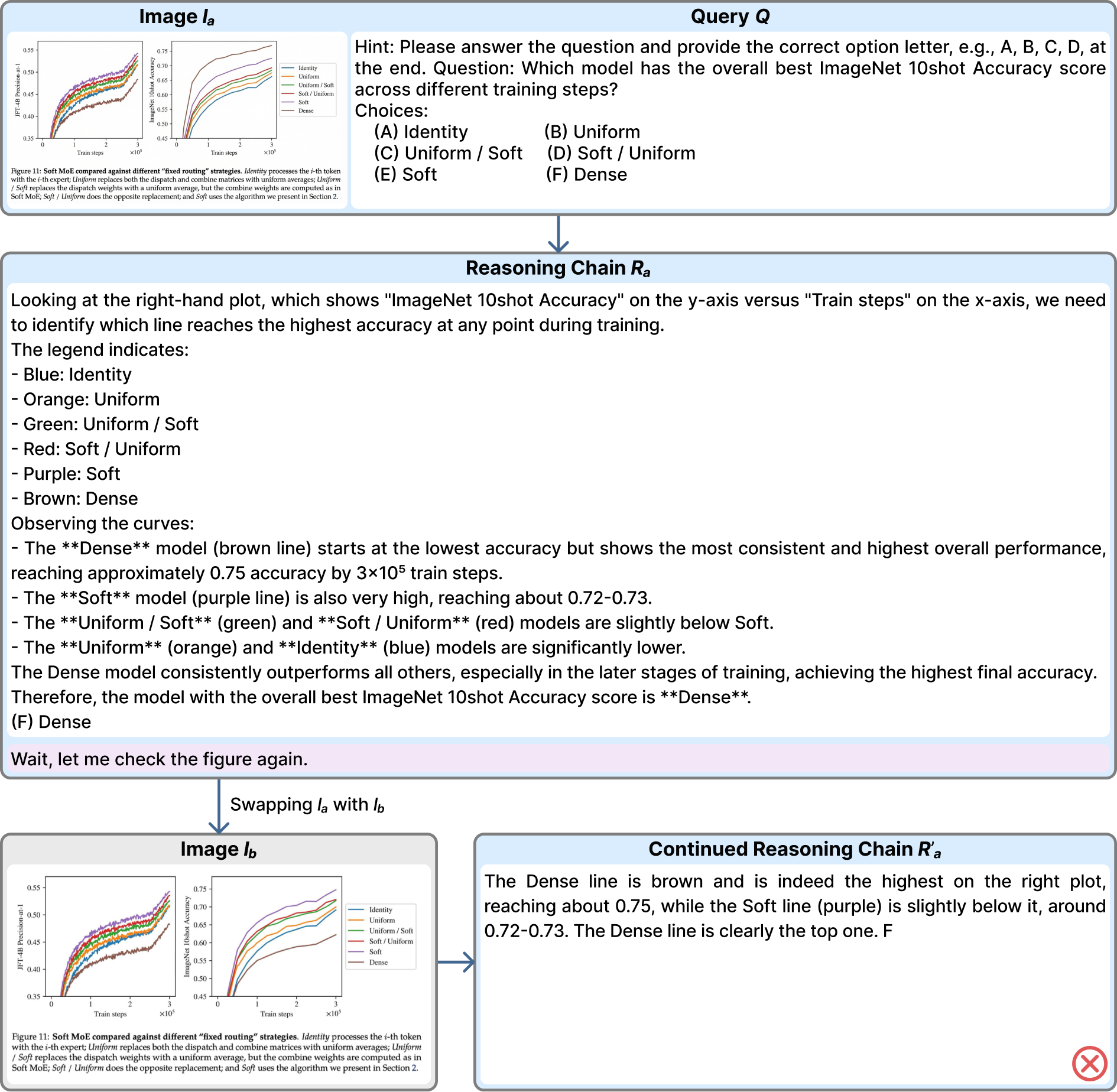
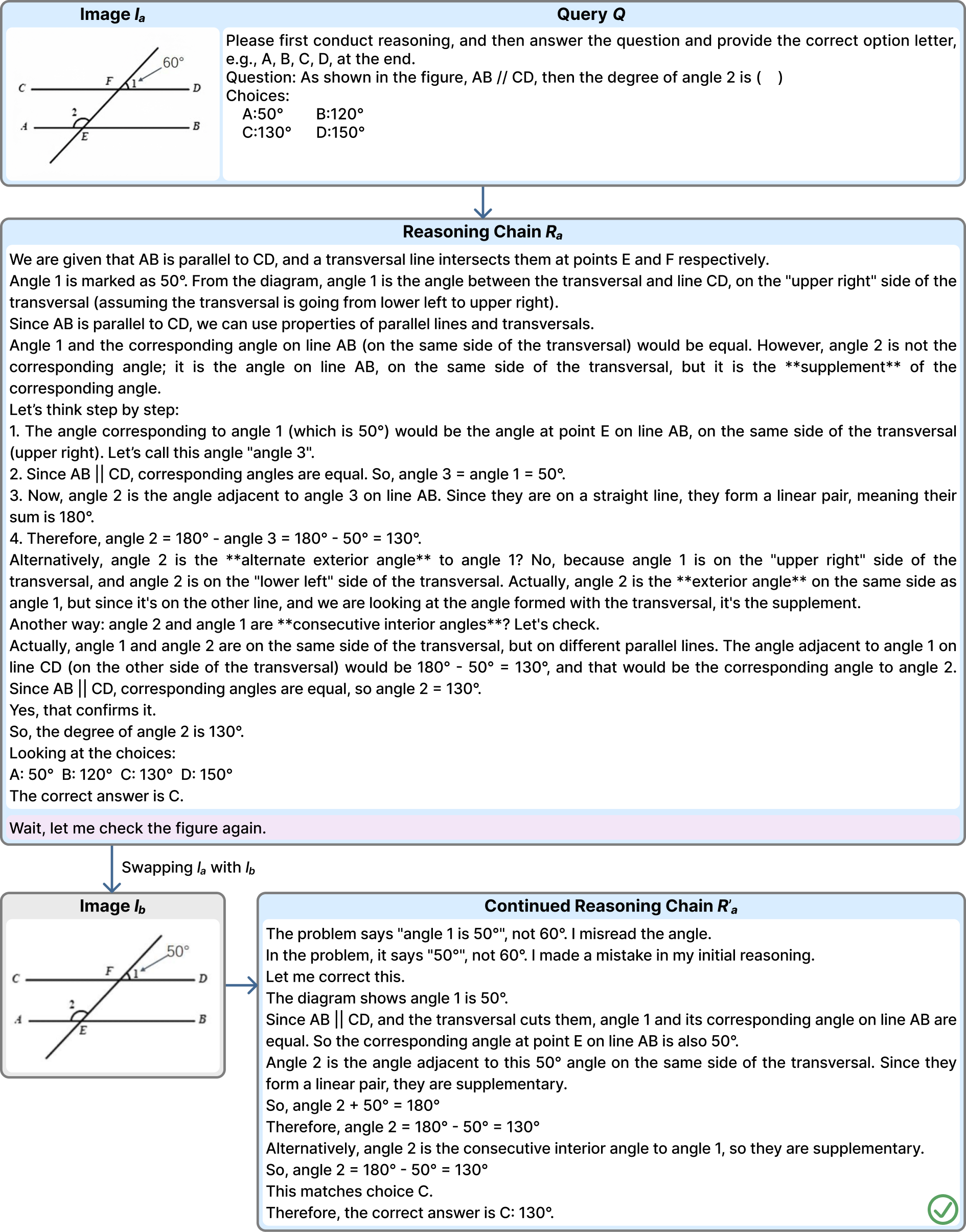
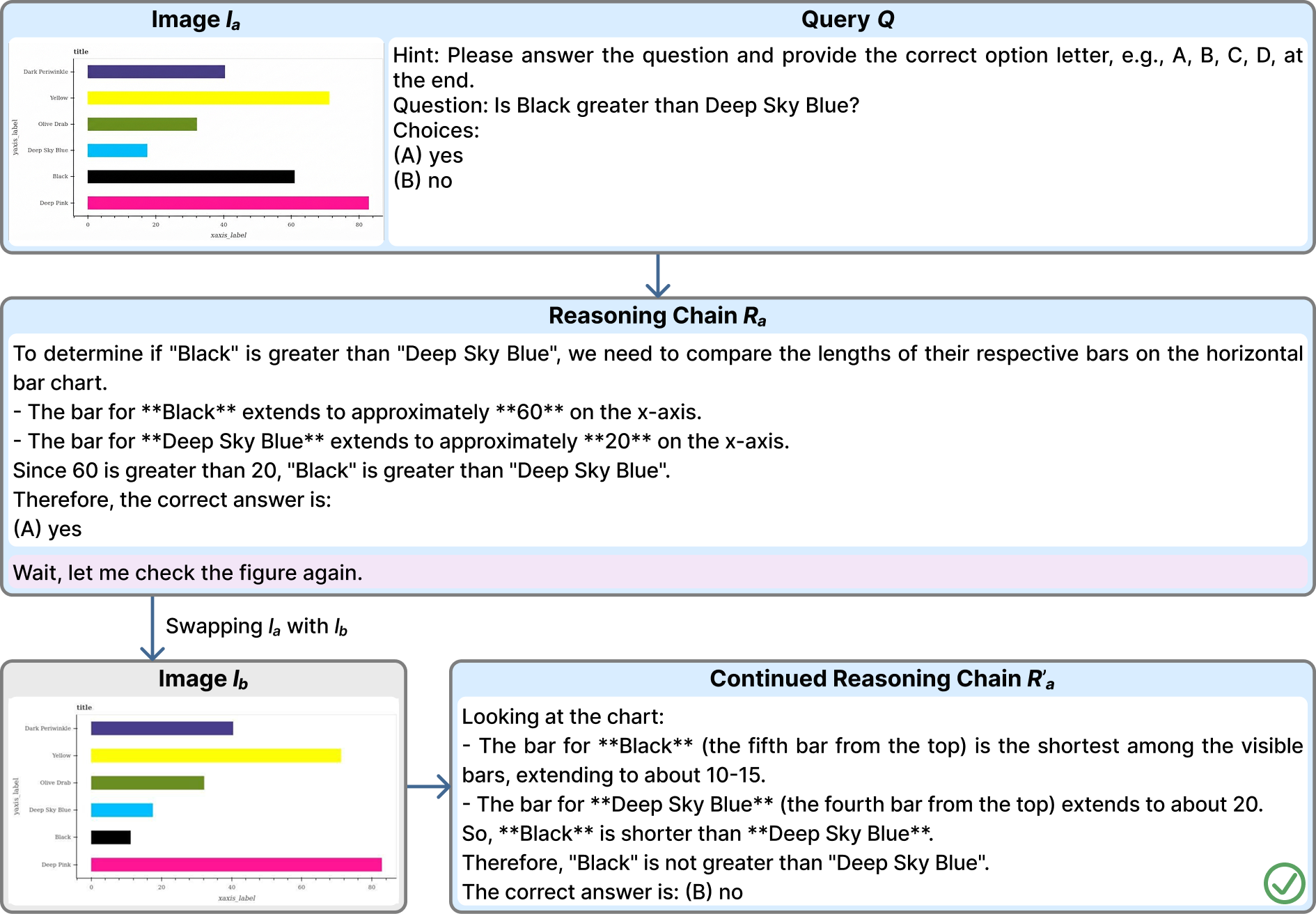
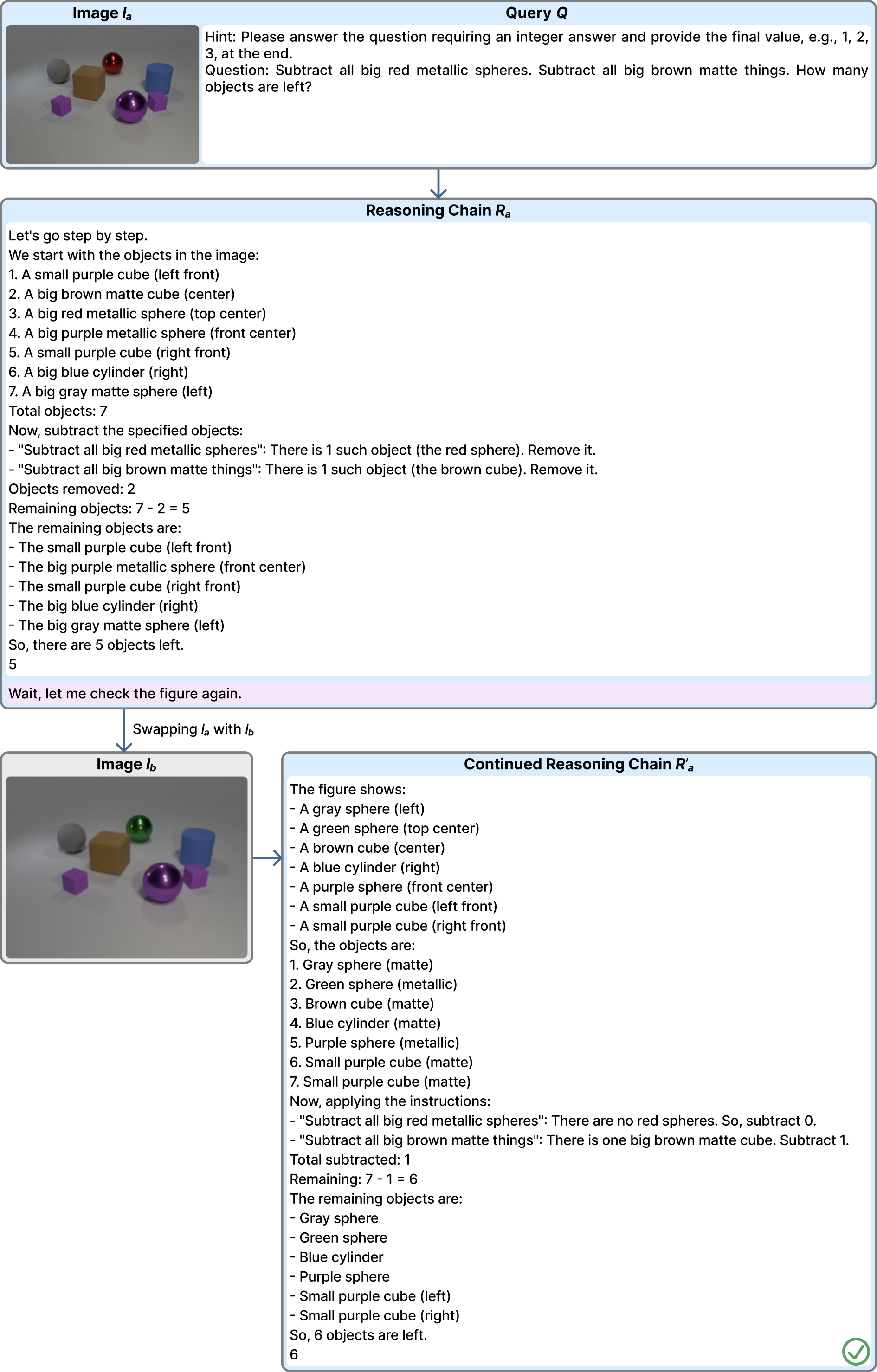
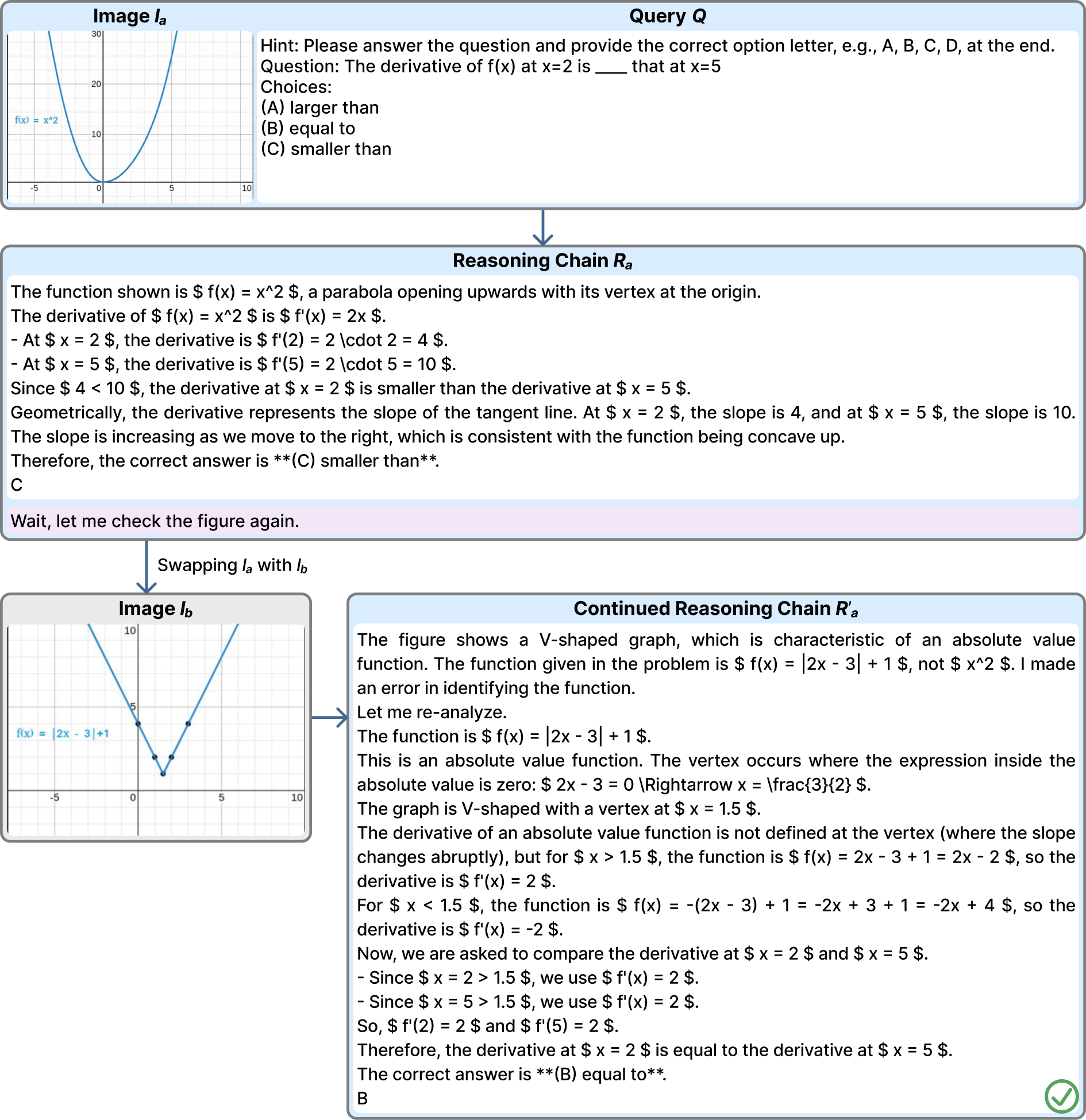
Given the original image Ia and question Q, the VLM generates a reasoning chain Ra through standard inference, grounded in the visual content of Ia.
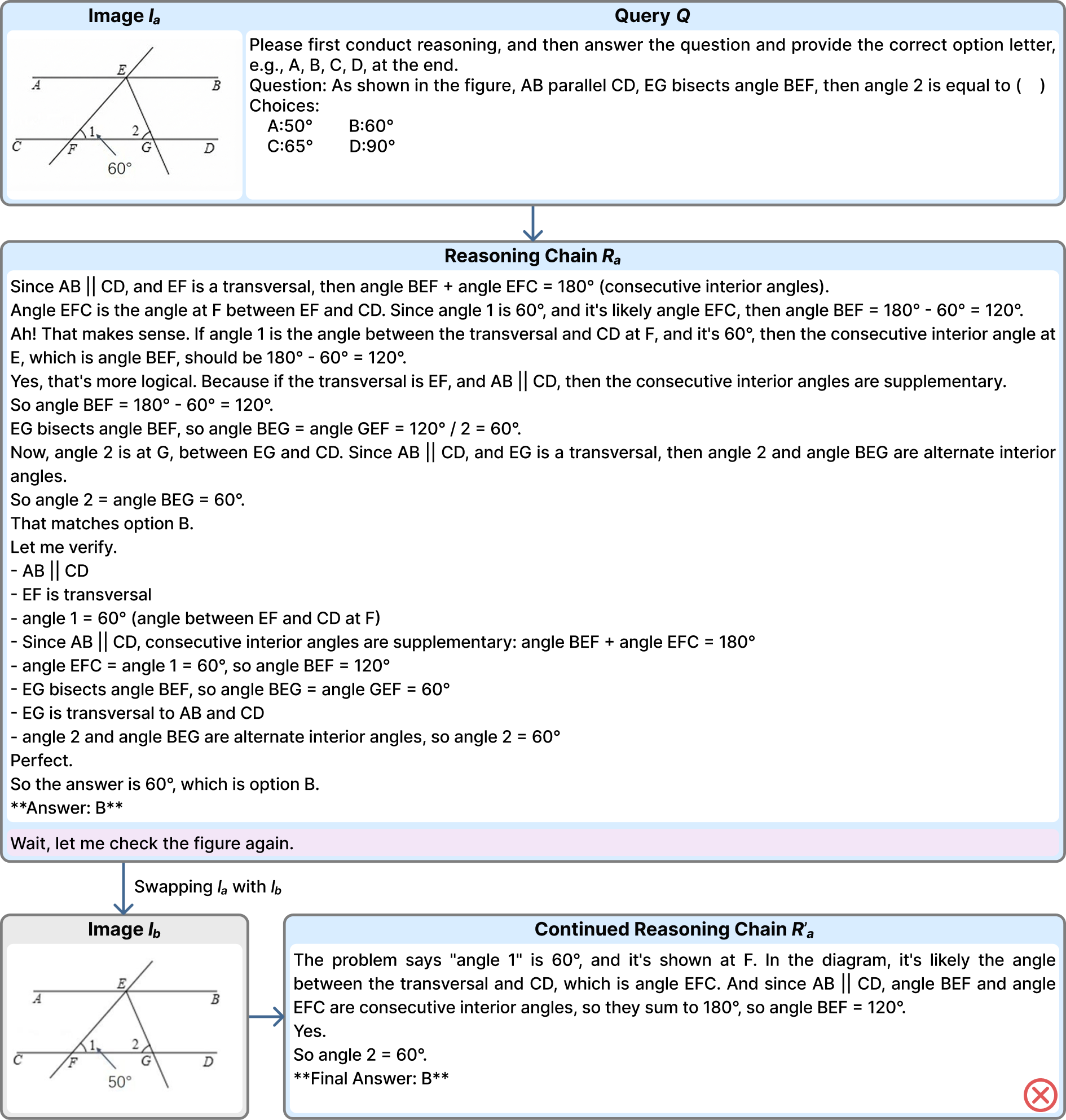
We append a reflection prompt (e.g., "Wait, let me check the figure again") to Ra, while simultaneously replacing Ia with a visually similar but semantically distinct image Ib. The model continues generation from this point.
We measure Performance Degradation Δ = Accbase − Accprobe. Large Δ reveals that the model anchors to prior text rather than re-attending to the current visual evidence.
Evidence
Across 15 models spanning Qwen3-VL, Qwen2.5-VL, Kimi-VL, and ERNIE-VL families, VisualSwap exposes a consistent failure: models say they re-examine, but they don't. The strongest models suffer the largest drops, and explicit multi-turn user instructions are the only intervention that reliably restores grounding.
Table 1. Main results on VS-Bench — Base and Probe accuracy with the performance drop (Δ) across 15 VLMs.
| Model | Variant | MathVista | MathVerse | MathVision | MMMU-Pro | Avg. | ||||||||||
|---|---|---|---|---|---|---|---|---|---|---|---|---|---|---|---|---|
| AccBase | AccProbe | Δ | AccBase | AccProbe | Δ | AccBase | AccProbe | Δ | AccBase | AccProbe | Δ | AccBase | AccProbe | Δ | ||
| Qwen3-VL-8B | Instruct | 82.5 | 55.0 | 27.5 | 70.5 | 44.0 | 26.5 | 49.5 | 31.0 | 18.5 | 74.0 | 56.5 | 17.5 | 69.1 | 46.6 | 22.5 |
| Thinking | 84.5 | 36.5 | 48.0 | 83.0 | 29.5 | 53.5 | 56.0 | 27.0 | 29.0 | 80.5 | 53.5 | 27.0 | 76.0 | 36.6 | 39.4 | |
| Qwen3-VL-32B | Instruct | 87.5 | 59.0 | 28.5 | 84.0 | 70.5 | 13.5 | 60.0 | 43.5 | 16.5 | 87.0 | 74.0 | 13.0 | 79.6 | 61.8 | 17.9 |
| Thinking | 94.5 | 33.0 | 61.5 | 89.5 | 24.0 | 65.5 | 67.0 | 32.0 | 35.0 | 88.5 | 57.5 | 31.0 | 84.9 | 36.6 | 48.3 | |
| Qwen3-VL-30B-A3B | Instruct | 84.5 | 49.5 | 35.0 | 70.5 | 55.5 | 15.0 | 49.0 | 29.5 | 19.5 | 78.0 | 64.0 | 14.0 | 70.5 | 49.6 | 20.9 |
| Thinking | 88.5 | 18.0 | 70.5 | 89.5 | 10.0 | 79.5 | 62.5 | 24.5 | 38.0 | 84.0 | 54.0 | 30.0 | 81.1 | 26.6 | 54.5 | |
| Qwen3-VL-235B-A22B | Instruct | 89.0 | 62.5 | 26.5 | 83.5 | 63.5 | 20.0 | 62.5 | 40.5 | 22.0 | 89.5 | 78.5 | 11.0 | 81.1 | 61.3 | 19.9 |
| Thinking | 93.5 | 29.5 | 64.0 | 96.5 | 22.5 | 74.0 | 74.0 | 31.0 | 43.0 | 91.0 | 53.5 | 37.5 | 88.8 | 34.1 | 54.6 | |
| ERNIE-4.5-VL-28B-A3B | Instruct | 76.0 | 33.0 | 43.0 | 71.0 | 31.5 | 39.5 | 33.5 | 18.5 | 15.0 | 72.5 | 33.0 | 39.5 | 63.3 | 29.0 | 34.3 |
| Thinking | 87.5 | 16.5 | 71.0 | 91.0 | 13.0 | 78.0 | 60.5 | 27.5 | 33.0 | 80.5 | 21.5 | 59.0 | 79.9 | 19.6 | 60.3 | |
| Kimi-VL-A3B | Instruct | 75.0 | 31.0 | 44.0 | 43.5 | 16.0 | 27.5 | 26.0 | 17.0 | 9.0 | 49.0 | 21.5 | 27.5 | 48.4 | 21.4 | 27.0 |
| Thinking | 87.5 | 28.5 | 59.0 | 69.5 | 19.5 | 50.0 | 52.5 | 26.0 | 26.5 | 69.5 | 35.5 | 34.0 | 69.8 | 27.4 | 42.4 | |
| Qwen2.5-VL-7B | Instruct | 72.5 | 37.5 | 35.0 | 49.5 | 36.0 | 13.5 | 25.5 | 15.5 | 10.0 | 47.0 | 28.5 | 18.5 | 48.6 | 29.4 | 19.3 |
| OpenVLThinker-7B | Thinking | 77.5 | 42.5 | 35.0 | 51.0 | 35.0 | 16.0 | 25.0 | 15.5 | 9.5 | 48.0 | 21.5 | 26.5 | 50.4 | 28.6 | 21.8 |
| VL-Rethinker-7B | Thinking | 79.0 | 33.0 | 46.0 | 66.0 | 32.0 | 34.0 | 31.5 | 26.5 | 5.0 | 50.5 | 18.5 | 32.0 | 56.8 | 27.5 | 29.3 |
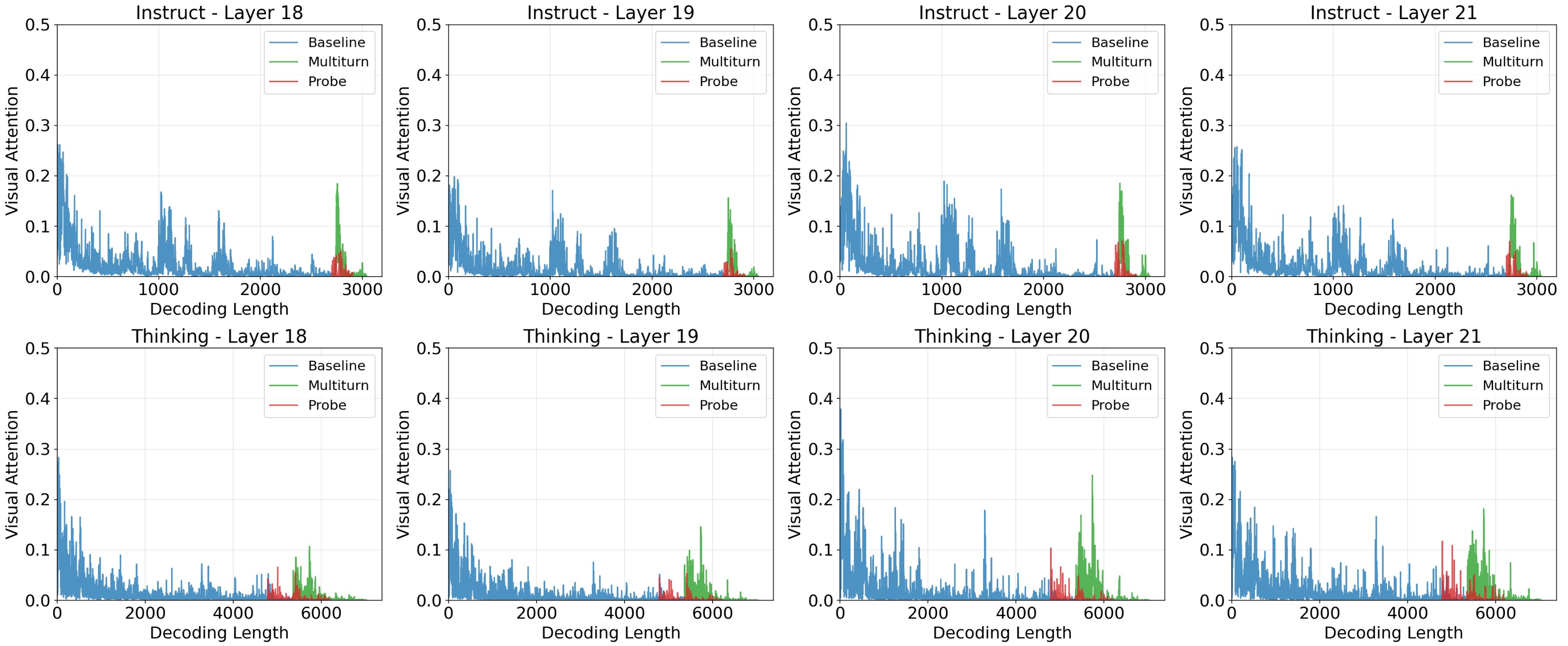
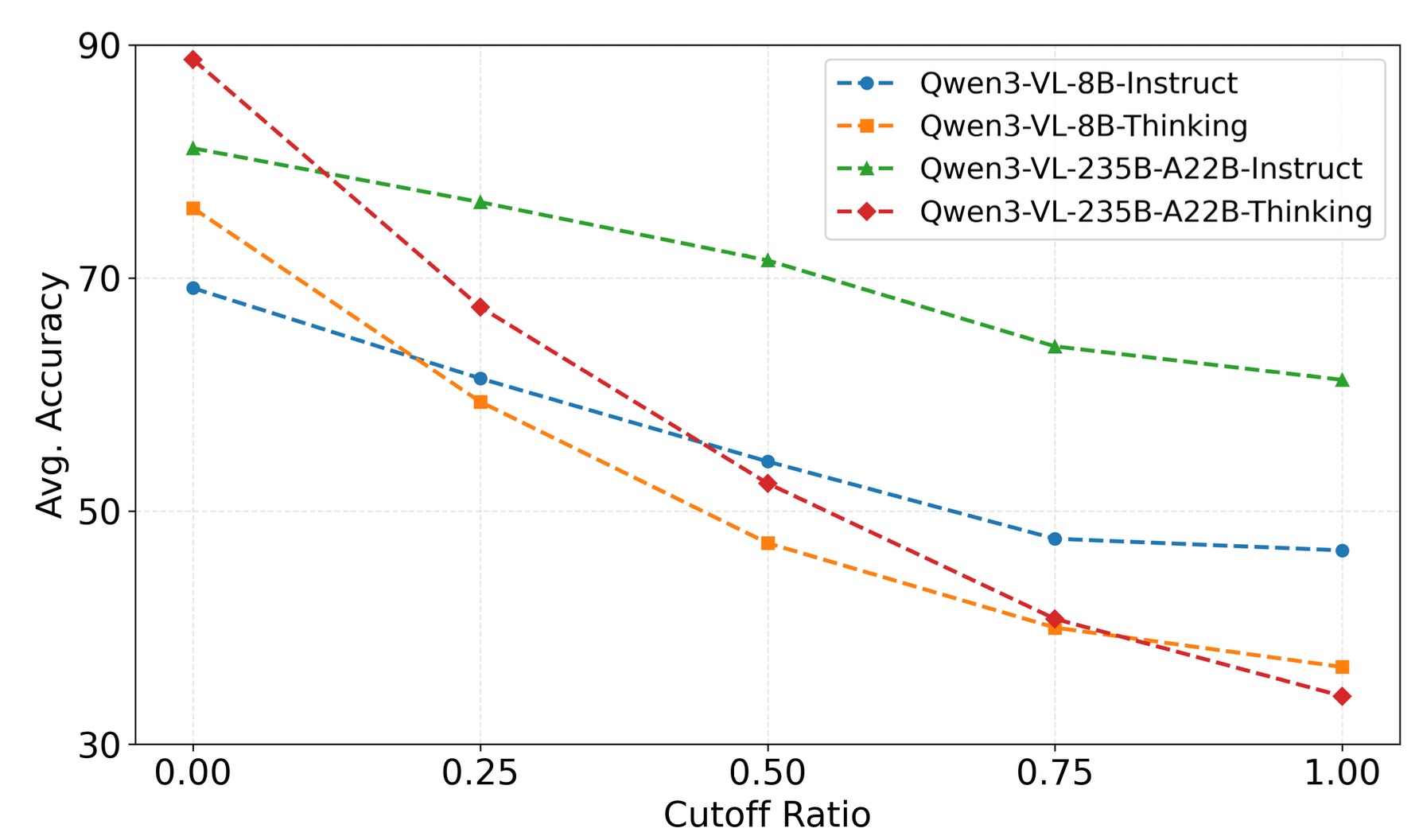
Table 2. Per-benchmark accuracy under Base, Probe, and Multi-turn settings.
| Model | Variant | MathVista | MathVerse | MathVision | MMMU-Pro | ||||||||
|---|---|---|---|---|---|---|---|---|---|---|---|---|---|
| Base | Probe | Multi | Base | Probe | Multi | Base | Probe | Multi | Base | Probe | Multi | ||
| Qwen3-VL-8B | Instruct | 82.5 | 55.0 | 68.4 | 70.5 | 44.0 | 53.5 | 49.5 | 31.0 | 42.0 | 74.0 | 56.5 | 69.0 |
| Thinking | 84.5 | 36.5 | 71.5 | 83.0 | 29.5 | 77.0 | 56.0 | 27.0 | 47.0 | 80.5 | 53.5 | 74.5 | |
| Qwen3-VL-235B-A22B | Instruct | 89.0 | 62.5 | 83.2 | 83.5 | 63.5 | 82.0 | 62.5 | 40.5 | 55.0 | 89.5 | 78.5 | 91.5 |
| Thinking | 93.5 | 29.5 | 83.2 | 96.5 | 22.5 | 97.0 | 74.0 | 31.0 | 71.5 | 91.0 | 53.5 | 90.0 | |
Media
Representative examples across four domains — Geometry, Chart Understanding, Synthetic Scene VQA, and Function Plots — illustrating both the dominant failure mode (textual inertia) and cases of genuine visual re-grounding. Use the arrows, dots, or ←/→ keys to browse; click any figure to enlarge.
Reference
@misc{shi2026vlmsseeingjustsaying,
      title={Are VLMs Seeing or Just Saying? Uncovering the Illusion of Visual Re-examination},
      author={Chufan Shi and Cheng Yang and Yaokang Wu and Linhao Jin and Bo Shui and Taylor Berg-Kirkpatrick and Xuezhe Ma},
      year={2026},
      eprint={2605.15864},
      archivePrefix={arXiv},
      primaryClass={cs.CV},
      url={https://arxiv.org/abs/2605.15864},
}
Notes
This work is funded in part by the Schmidt Foundation and by the National Science Foundation under grant 2146151. We thank the authors of MathVista, MathVerse, MathVision, and MMMU-Pro for releasing the benchmarks that VS-Bench builds upon, and the open-source teams behind Qwen3-VL, Qwen2.5-VL, Kimi-VL, and ERNIE-4.5-VL for making this analysis possible.